How to Meet OHS Inspection Requirements for Training
What OHS Inspectors Actually Look For
When an OHS Officer visits a worksite in Alberta, certificates alone aren’t what’s being checked. The whole picture is reviewed: whether training was delivered by an approved provider, whether records are current and accessible, whether the right number of certified workers are on shift, and whether the training itself was appropriate for the hazards present. Gaps in any one of these areas can result in orders, fines, or stop-work directives. In many cases, employers are caught off guard not because training was skipped entirely, but because the program that was chosen didn’t meet the right standard. That distinction matters, and it tends to surface at the worst possible time.
Choosing a Compliant Training Provider
Not every training provider is created equal. In Alberta, first aid training providers must appear on the Alberta Approved Training Agencies list, which is maintained by Alberta OHS, and employers are responsible for approving those providers before workers are enrolled. A reputable course needs to be compliant with Provincial Legislation, meet the most recent CSA standards, meet Industry Best Practices, and follow the Principles of Adult Education. Alberta’s requirements also align with CSA Standard Z1210-17, which helps harmonize certification across Canada. If those criteria can’t be confirmed by a provider, that’s a signal worth paying attention to; over time, the cost of choosing the wrong program tends to outweigh any short-term savings.
Understanding the First Aid Course Requirements
Basic (Emergency) First Aid is a 1-day, 8-hour course. Intermediate (Standard) First Aid runs 2 days at 16 hours total, though it can also be completed in a blended format requiring 5 hours of online theory and 1 full day of in-person practical skills. Core modules are covered in both courses, including Airway Management, Breathing Management, Cardiovascular Emergencies, Medical Emergencies, and Spinal and Neurological Emergencies. The content is similar between the two levels, but additional skills are required in Intermediate First Aid beyond what Basic covers. For workers who currently hold a valid Intermediate First Aid certificate, a 1-day re-certification course is available. Regardless of how theory was completed, all hands-on practical skills must be demonstrated in person with an approved trainer.
How Many First Aiders Does Your Workplace Need?
This is where a lot of employers underestimate their obligations. The required number of certified first aiders isn’t fixed; it depends on the degree of hazard at the worksite, which is classified as low, medium, or high, the number of workers on shift at any given time, and the distance from the site to the nearest healthcare facility. A remote industrial site with high-hazard work and 30 workers on shift will have very different requirements than a small office. First Aid certifications are provincially recognized and valid for 3 years. Basic Life Support CPR carries its own separate renewal requirements, and those timelines should be verified independently by employers to avoid lapses. I suppose that’s an easy thing to let slip, in a way.
Training Structure: What a Compliant Program Looks Like
A compliant training program isn’t just a presentation followed by a handshake. A knowledge portion with testing must be included, followed directly by a practical hands-on skill demonstration and testing portion. Both components are required. The knowledge portion confirms that workers understand the material; the practical portion confirms it can be applied under realistic conditions. Classes are structured to run with 6 to 20 participants, which supports the kind of hands-on engagement that adult learners need. After certification is issued, the training fundamentals are expected to be taken by employers and applied to their specific workplace to ensure worker competency. That sounds straightforward on paper, but in practice it requires deliberate follow-through on the employer’s part.
Industrial-Specific Training Requirements
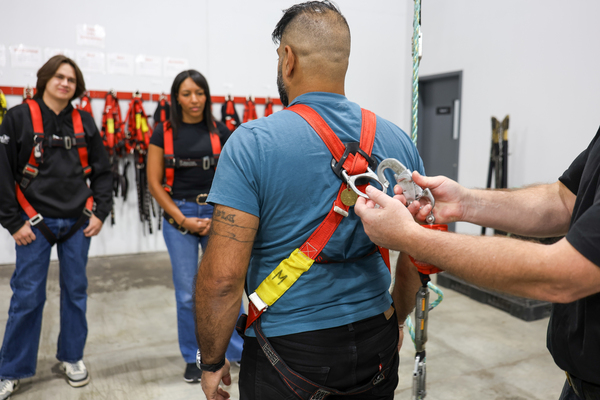
Workplace safety training in Alberta’s construction and industrial sectors goes well beyond first aid. Depending on the nature of the work, training may also be required for working at height, powered mobile equipment operation, confined space entry, and chemical exposure. Each of these areas carries its own documentation and competency requirements. A CPR Training course or First Aid Training course covers emergency response, but hazard-specific training for the equipment and environments workers encounter daily isn’t replaced by those programs. Compliance with Alberta’s occupational health and safety laws is required for each training area, and identifying which programs apply to specific operations is a responsibility that sits with the employer.
Documenting Training Records Correctly
Documentation is often where otherwise solid programs fall apart during an inspection. Training records must be maintained for all workers, kept current, and made readily available if they are requested by an OHS inspector. This applies to every workplace, not just construction sites or high-hazard environments. Records should include the course name, the date of completion, the provider’s name, and the certificate expiry date. First aid supplies must also be readily available on site, and their presence is typically verified during an inspection alongside training records. Anyway, that’s usually where it clicks for employers: the training itself was fine, but the paper trail wasn’t there to prove it.
Taking the Next Step Toward Compliance
Getting a workplace safety training program into full compliance with Alberta OHS requirements takes some planning, but it’s manageable when broken down into clear steps. It’s worth confirming that First Aid training providers appear on the Alberta Approved Training Agencies list before any workers are enrolled. Courses should be verified as compliant with Provincial Legislation, aligned with the most recent CSA standards, and built to follow the Principles of Adult Education. Training records should be audited to confirm certificates are current and documentation is complete. And the number of certified first aiders on each shift should reflect the site’s hazard level and worker count. Visit our website at wcff.ca to learn more about how Western Canada Fire & First Aid supports Alberta employers in meeting these requirements.
FAQ
Q: Who is responsible for making sure a training program meets OHS requirements? Training agencies or providers must ensure their first aid program meets OHS requirements. Training must be selected so that it meets requirements capable of withstanding scrutiny from an Occupational Health and Safety Officer. A certificate being issued doesn’t automatically mean the program was compliant. That still surprises people.
Q: Does a training provider need to be approved before we use them? Yes, and this is one of the more commonly overlooked steps. Training providers for first aid must be found on the Alberta Approved Training Agencies list, which is maintained by Alberta OHS. Compliance with Alberta’s occupational health and safety laws is required for the training course itself. Employers must approve training providers before sending workers through any program.
Q: Can workers complete their first aid training entirely online? No. Theory can be completed online or in a classroom setting, but hands-on practical skills must always be demonstrated in person with an approved trainer. That requirement applies to both Basic (Emergency) First Aid and Intermediate (Standard) First Aid. The practical portion isn’t optional, and it isn’t something that can be assessed remotely.
Q: What happens after a worker receives their certification? Good question. Certification marks the end of the formal training process, but not the end of the employer’s responsibility. After certification is issued, employers are expected to take the training fundamentals and apply them to their specific workplace to ensure worker competency. The certificate confirms baseline knowledge. Applying that knowledge to real site conditions is a separate step that falls on the employer.



0 Comments