Forklift Training for Employers: Build Safer Warehouse Operations
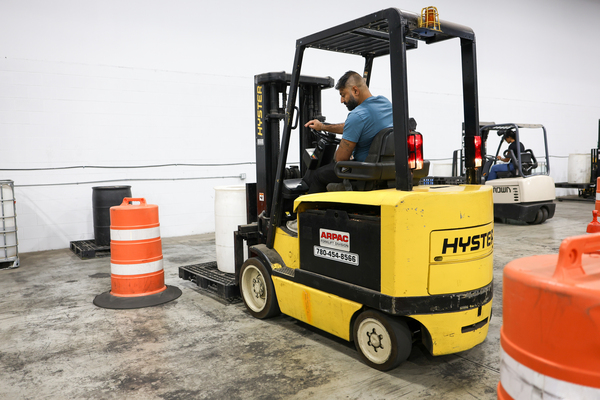
Why Forklift Training Is an Employer Responsibility
Under Alberta’s OHS legislation, responsibility for worker safety is placed primarily on the employer, but responsibility for worker safety is also shared with the employee. Training includes making sure every forklift operator has completed proper training before a load is ever moved. An employer who assumes a worker knows what they’re doing because they’ve done it somewhere else isn’t enough. Training must be verified, documented, and matched to the equipment being used. From what we’ve seen, the employers who run into problems during inspections are usually the ones who relied on informal on-the-job experience instead of a structured program. Competency has to be demonstrated, not assumed.
What a Proper Forklift Training Program Looks Like
Reputable forklift training programs must be compliant with Provincial Legislation, follow the most recent CSA standards, meet Industry Best Practices, and meet the Principles of Adult Education. That’s a specific set of criteria, and it matters when an OHS Officer comes knocking. A knowledge portion with testing should be included in the program, followed directly by a practical hands-on skill demonstration and testing portion. Theory instruction covers equipment types, load dynamics, forklift stability, workplace hazards, and safe operating procedures, while the hands-on session addresses basic operation, maneuvering, load handling, and stacking. Both components are required. One without the other isn’t enough, to be fair.
How Long Does Forklift Training Take?
For a new operator learning the basics, training typically runs 6 to 8 hours, though that range isn’t fixed. Timing ultimately depends on the operator’s skill level. Workers with some prior experience on powered mobile equipment may move through the material more quickly, while others may need additional time on the practical side. Training providers must be approved by employers, who are also expected to confirm that the program structure suits their workers and their specific worksite. After certification is issued, the training fundamentals are expected to be applied by employers to their specific workplace to ensure worker competency, and over time, that’s usually where it clicks for most supervisors. Interesting how that works.
Equipment-Specific Training: Why It Matters
Not all forklifts are the same. A counterbalance forklift handles very differently from a narrow-aisle reach truck or a powered pallet jack; each piece of equipment carries its own turning radius, load capacity, and visibility limitations. General principles that apply across equipment types can be covered in theory instruction, but the hands-on portion must be conducted on the actual equipment the operator will use in their role. Employers running multiple equipment types should confirm that each one is specifically addressed in their training program. In many cases, workers who are competent on one machine will still need supervised practice before being cleared to operate another, and that’s worth planning for.
Forklift Training and First Aid: A Combined Approach to Workplace Safety
Forklift training is one piece of a broader workplace safety program. In Alberta’s construction and industrial sectors, employers are also required to ensure that an appropriate number of trained first aiders are available on site. The number required is determined by the degree of hazard (low, medium, or high), the number of workers on shift, and the distance to a healthcare facility. Workers in these environments may benefit from completing a Basic (Emergency) First Aid course, which is a 1-day, 8-hour program, or an Intermediate (Standard) First Aid course, which runs 2 days at 16 hours. Hands-on practical skills must be demonstrated in person with an approved trainer, regardless of which course is taken.
Documented Training Records: A Mandatory Requirement
Documented training records aren’t optional; they’re a mandatory requirement for all workplaces in Alberta, not just those in high-hazard industries. If an OHS Officer asks to see proof that forklift operators have completed proper training, that proof needs to be available. Records should include the operator’s name, the date training was completed, the equipment covered, and the name of the training provider. Training programs must meet requirements that can withstand scrutiny from Occupational Health and Safety Officers, and that responsibility sits with the employer. Keeping clean, organized records is one of the simpler things a safety program can get right, and it’s often the first thing checked.
Choosing the Right Training Provider in Alberta
Training providers must be approved by employers. That responsibility sits with the company, not with any external body. When a program is being evaluated, compliance with Alberta’s occupational health and safety laws should be confirmed as a requirement for the training course. Both a knowledge portion with testing and a hands-on practical session with testing should be present in any program worth considering. Cost generally ranges from $175 to $400 depending on a forklift operator’s skill level, so it’s worth factoring in whether the provider can also accommodate your team’s schedule and worksite requirements. Classes typically run with 6 to 16 participants. If a broader workplace safety training program is being built, one that includes Forklift Training alongside first aid courses, visit our website to learn more about what Western Canada Fire & First Aid offers for Alberta employers.
FAQ
Q: Is certified forklift training legally required in Alberta? Yes. Workers are required by Alberta’s occupational health and safety laws to be trained and competent before powered mobile equipment, including forklifts, is operated. Compliance with Alberta’s occupational health and safety laws is required for the training course itself. Employers are responsible for ensuring that training has been completed and documented. That still surprises people.
Q: Does forklift training cover multiple equipment types? Not always, but it should. Reputable programs are designed to address different equipment categories, including counterbalance forklifts, narrow-aisle reach trucks, and powered pallet jacks. Theory instruction typically covers the principles that apply across equipment types, while the hands-on portion is conducted on the specific equipment the operator will use. Each machine has its own handling characteristics, so equipment-specific training matters.
Q: Do operators need an Alberta driver’s license to run a forklift? No, an Alberta driver’s license is not a legal requirement for forklift operation unless operating on the roadway. That said, holding one can be genuinely useful. Workers who already understand basic vehicle controls, including pedals, steering wheels, and seat belts, tend to adapt to forklift operation more quickly. Not a requirement. But not irrelevant either.
Q: When does a forklift operator need to be fully retrained? Full retraining is generally required when an operator’s certificate expires, an operator is new to the role, has been away from forklift work for an extended period, or has been involved in a forklift incident. Each situation should be evaluated by the employer to determine whether a refresher is enough or whether a complete program is needed. Documented retraining records should be kept on file for all workers.

0 Comments