first aid training for manufacturing teams in alberta: reducing response time
Why Response Time Gets Overlooked Until It Doesn’t
Manufacturing sites in Alberta run tight schedules, and safety training sometimes gets treated as a box to check rather than a working system. That’s a mistake, though an understandable one. A worker with a crush injury or an airway obstruction can’t wait for a supervisor to locate the nearest certified first aider; an immediate response is required. In many cases, the difference between a manageable injury and a serious outcome comes down to who was standing nearby, and whether that person had actually practiced the skill recently, not just passed a test once. Training records get checked. Supplies get checked, too. But actual readiness, that’s harder to audit, and it’s easy to assume.
What Alberta Actually Requires
Alberta’s OHS regulations are built along with CSA Standard Z1210-17, which harmonizes First Aid certification across the country. Providers must be listed on the Alberta Approved Training Agencies list maintained by Alberta OHS, so not every course marketed as “certified” will hold up under review. Once issued, certifications are provincially recognized for 3 years. The number of first aiders required on a given shift is shaped by the degree of hazard (low, medium, high), how many workers are present, and how far the site sits from a healthcare facility. A plant near Edmonton with quick hospital access carries different obligations than a remote facility three hours out. Compliance with Alberta’s occupational health and safety laws is required for the training course itself.
Basic vs. Intermediate, and Why the Distinction Matters
Basic (emergency) First Aid runs 1 day, roughly 8 hours, and covers foundational response skills. Intermediate (standard) First Aid extends this to 2 days, 16 hours total, with added depth in areas like spinal and neurological emergencies. The core content between the two courses is fairly similar; Intermediate simply builds on it, with more advanced hands-on skills and a more demanding practical testing portion. Some Alberta manufacturers assume Basic is sufficient because it’s shorter, but that decision should be driven by the hazard assessment, not the schedule. A blended format is also offered for Intermediate: 5 hours online plus 1 day in person for the practical component. For workers who already hold a valid Intermediate certificate, a 1-day re-certification course exists, and renewal costs are kept down without skill retention being cut short.
The Curriculum That Actually Builds Response Speed
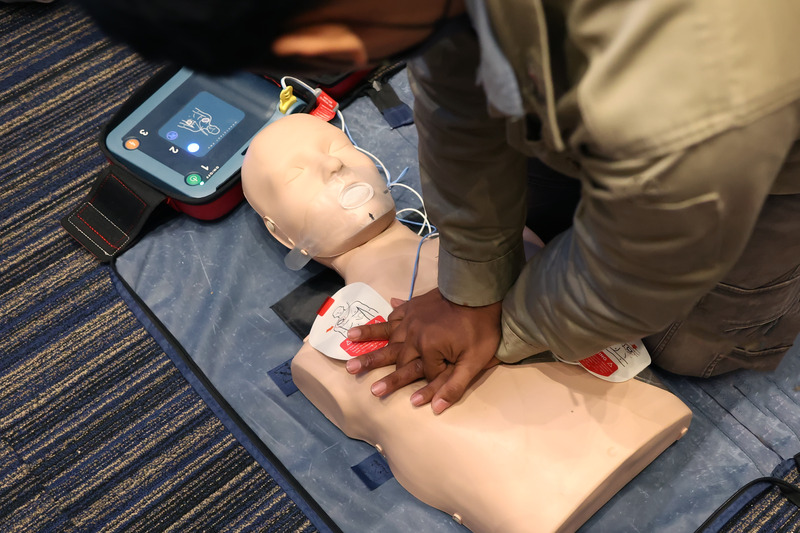
A reputable First Aid course walks through Airway Management, Breathing Management, Medical Emergencies, and Spinal and Neurological Emergencies, among other modules. Knowledge instruction is paired with testing in each module, followed directly by a hands-on skill demonstration and testing portion; theory alone doesn’t count. For manufacturing environments specifically, Fall Protection and powered mobile equipment awareness often need to be layered in alongside confined spaces and chemical exposure response. A worker who’s only studied general First Aid may freeze slightly when the emergency involves machinery, not a simple fall. That gap is closed, at least in part, by practicing against realistic scenarios, from what we’ve seen across industrial sites in Alberta.
Certification Isn’t the Finish Line
Here’s something that gets missed: once certification is issued, the responsibility doesn’t end there. The training fundamentals are expected to be applied by employers directly to their own workplace, so that each worker’s competency holds up under real conditions, not just classroom conditions. It’s on the employer to confirm that training meets requirements strong enough to withstand scrutiny from an OHS Officer during an unannounced site visit. Documented training records and readily available First Aid supplies aren’t just good practice; they’re mandatory across all workplaces, not only construction projects. The same documentation standard is faced by a manufacturing floor in Red Deer as by a downtown Calgary facility.
A Small Alberta Example
A mid-sized parts manufacturer outside Lethbridge had a minor training gap; two shift leads let their certifications lapse without flagging it internally. Nothing happened for months. Then a worker suffered a laceration near a press machine, and the nearest trained responder was found on break in another building. The delay wasn’t long, maybe four minutes, but it was long enough to shake the safety committee into rebuilding their tracking system. Anyway, that’s usually where it clicks for a lot of teams: after something almost goes wrong, not before.
Building Response Time Into the Culture, Not Just the Schedule
Reducing response time isn’t a one-time training event; it’s closer to an ongoing habit, reinforced through repetition, and refreshers. Workplace Safety training works best when it’s treated as part of the operational rhythm, not an annual obligation buried in a compliance binder. Fewer coverage gaps tend to be seen at sites that schedule refreshers ahead of certification expiry, rather than scrambling afterward, from what we’ve observed. Bit by bit, that small shift in planning tends to make a real difference, over time.
Getting Started With Western Canada Fire & Fire Aid
Basic (emergency) First Aid, Intermediate (standard) First Aid, CPR Training course options, and Forklift Training are all offered by Western Canada Fire & Fire Aid, suited to Alberta’s industrial and manufacturing sector. Courses are structured around CSA standards, Provincial Legislation, and the Principles of Adult Education, with class sizes kept between 6 and 20 participants so hands-on skills actually get practiced properly. Visit Western Canada Fire & Fire Aid’s website to review course schedules and find the right fit for your site’s hazard level.
FAQ
Q: How does First Aid training actually reduce response time on a manufacturing floor?
Trained workers recognize an emergency faster, and hesitation is largely removed before action is taken. Response time is improved less by speed of movement and more by removing the delay caused by uncertainty. In a plant with confined spaces or chemical exposure risks, that hesitation gap matters, and it matters quite a bit. It’s a fragment, but it’s the whole point: hesitation kills time.
Q – Is Basic First Aid enough for a manufacturing site, or is Intermediate required?
Good question. It depends on the hazard assessment for the site, not just personal preference. Intermediate (standard) First Aid covers additional skills, though the core content overlaps quite a bit with Basic. Many industrial sites with higher hazard ratings are pushed toward Intermediate by their OHS Managers during inspection.
Q: Can the theory portion be completed online?
Yes. Theory instruction can be completed online or in a classroom setting, and Intermediate First Aid even offers a blended format with 5 hours online plus 1 day in person. That said, all hands-on practical skills are required to be demonstrated in person, with an approved trainer. No shortcuts there.
Q: Who is allowed to deliver this training in Alberta?
Training providers must appear on the Alberta Approved Training Agencies list, which is maintained by Alberta OHS. This is a government-regulated requirement, so it isn’t optional, or flexible, depending on the employer’s preference. Employers are still expected to confirm the provider’s standing before booking a course.


0 Comments