First Aid for Supervisors: What to Do Before Help Arrives
Why the First Few Minutes Matter More Than Most First Aiders Realize
In construction and industrial settings across Alberta, emergency response time from 911 dispatch to on-site arrival can range widely, depending on location, weather, and distance to a healthcare facility. That gap is real. During it, a worker’s outcome is largely shaped by whoever is closest and trained to help.
First aiders carry a specific responsibility here. Under Alberta OHS legislation, ensuring that injured workers receive prompt first aid isn’t optional; it’s a legal requirement. But beyond compliance, there’s a practical reality: a first aider who freezes, or who waits for someone else to act, is a liability the worksite can’t afford.
Proper Workplace Safety training closes that gap. Not just in theory, but in the moment it counts.
Secure the Scene Before You Touch Anyone
The first instinct is often to rush toward the injured worker. That’s understandable, but it can make things worse. In industrial environments, the hazard that caused the injury may still be active, and a worker down near powered mobile equipment, a chemical spill, or an active work area needs the scene assessed before anyone approaches.
A few quick checks are needed: Is the area safe to enter? Are other workers at risk? Has the hazard been contained, or is it still present?
Only after the scene is reasonably secured should direct care be started. This step is covered in Intermediate (Standard) First Aid training and is built into the practical skills testing component. Skipping it, even with good intentions, can turn one casualty into two.
The Call to 911 and What to Say
Calling emergency services sounds straightforward. In practice, a panicked call with incomplete information slows response, sometimes significantly. The dispatcher should be given the site address, a clear description of what happened, the number of people injured, and the current condition of the worker.
Someone should be assigned to physically meet EMS at the site entrance; it’s a small step, in a way, that saves real time. Industrial and construction sites in Alberta can be large, gated, or poorly marked from the road. EMS shouldn’t be navigating that alone.
While the call is being managed and the meeting point is arranged, the trained first aider should already be working. Parallel action matters here.
Starting First Aid: Airway, Breathing, and CPR
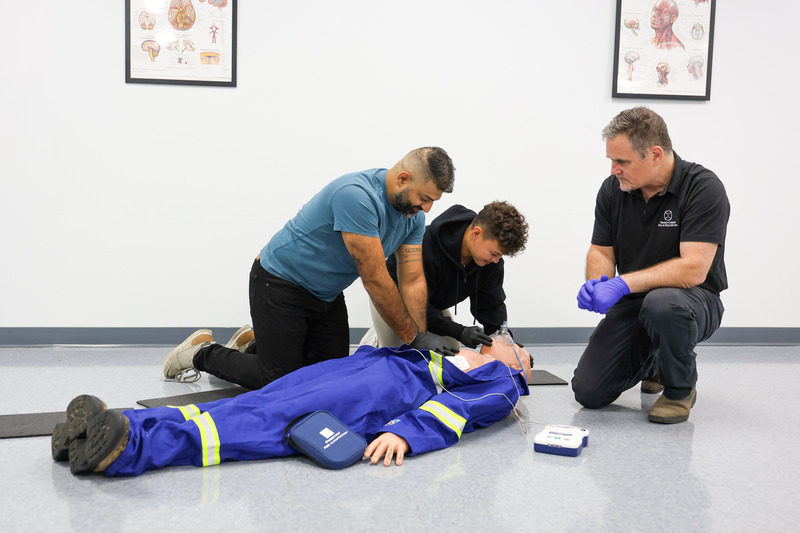
Once the scene is safe and EMS is on the way, first aid begins. The sequence stays consistent regardless of the specific emergency: scene is secured, responsiveness is checked, the airway is opened and managed, breathing is assessed, and CPR is started if the worker is unresponsive and not breathing normally.
These steps are covered in both Basic (Emergency) First Aid and Intermediate (Standard) First Aid courses. The curriculum includes dedicated modules on Airway Management, Breathing Management, Cardiovascular Emergencies, Medical Emergencies, and Spinal and Neurological Emergencies. Theory instruction builds the knowledge base; the hands-on practical component, which must be completed in person with an approved trainer, is where the skill actually gets tested.
CPR Training courses reinforce this sequence specifically, and Basic Life Support CPR renewal should be tracked separately from the first aid certificate itself.
Handling Specific Industrial Emergencies
Construction and industrial worksites in Alberta carry a range of hazards that general first aid guidance doesn’t always address directly. Falls from height, incidents involving powered mobile equipment, confined space rescues, and exposure to hazardous materials each call for a modified response; over time, workplace first aiders who’ve seen these situations tend to understand why the specifics matter.
For spinal injuries, movement should be minimized until EMS arrives, which is why Spinal and Neurological Emergencies is treated as a dedicated module in Intermediate First Aid. For chemical exposure, the worker should be removed from the source and the site’s safety data sheet protocols followed. Confined space incidents often require waiting for a trained rescue team rather than attempting entry. I suppose that last point is harder to accept in the moment, but it’s the right call.
Intermediate (Standard) First Aid builds on the core skills found in Basic (Emergency) First Aid, adding the depth needed for these more complex situations. The distinction matters when a worksite’s hazard classification is medium or high.
What Employers Are Required to Have in Place
First aid response doesn’t start when someone gets hurt. It starts with the systems put in place before anything happens. Under Alberta OHS legislation, all workplaces, not just construction sites, are required to maintain documented training records, keep first aid supplies readily available, and ensure the right number of trained first aiders are present based on hazard level, shift size, and distance to an approved healthcare facility.
First aid training providers must be listed on the Alberta Approved Training Agencies list provided by Alberta OHS, and that confirmation is the employer’s responsibility before workers are enrolled. Reputable courses must be compliant with Provincial Legislation, meet the most recent CSA standards, meet Industry Best Practices, and follow the Principles of Adult Education.
After certification is issued, the training fundamentals are expected to be applied to the specific workplace to ensure worker competency. That part doesn’t happen automatically.
Choosing the Right Course Level for Supervisors
Basic (emergency) First Aid is a 1-day (8-hour) course. Core emergency response is covered, and it’s appropriate for lower-hazard workplaces. Intermediate (standard) First Aid runs 2 days (16 hours) and is required in many medium and high-hazard environments common across Alberta’s industrial sector.
The blended format for Intermediate First Aid requires 5 hours of online theory instruction followed by 1 full day of in-person practical skills. All hands-on components must be completed with an approved trainer. Class sizes range from 6 to 20 participants, which keeps the practical sessions manageable and ensures proper skill assessment is carried out for each person.
For workers who already hold a valid Intermediate (standard) First Aid certificate, a 1-day re-certification course is available rather than repeating the full program. That’s usually the most efficient path back to compliance for anyone whose certificate has lapsed.
Getting Your Team Trained Through a Trusted Alberta Provider
Workplace first aiders in Alberta’s construction and industrial sectors carry real responsibility when emergencies happen on site. The training they complete needs to hold up, not just on paper, but under the scrutiny of an OHS Officer and, more importantly, in an actual emergency.
Training requirements must be met, and providers should be selected from the Alberta Approved Training Agencies list. Alberta regulations align with CSA Standard Z1210-17, which harmonizes certification across Canada. First aid certifications are provincially recognized, and the course completed today may be the credential that matters most in a future incident review.
Western Canada Fire & First Aid offers First Aid Training courses built for the realities of industrial and construction work in Alberta. Visit the website at wcff.ca to learn more about available course options and to get your team registered.
FAQ
Q: What is an employer’s legal responsibility during a workplace medical emergency in Alberta?
Under Alberta OHS legislation, employers are required to ensure injured workers receive first aid without delay. That responsibility doesn’t transfer to EMS when they’re still 20 minutes out. Care is expected to be initiated, the scene kept safe, and a record of what happened is to be documented. Documented training records are a mandatory requirement for all workplaces, not just high-risk ones. That still surprises people.
Q: Does a workplace need Intermediate (standard) First Aid, or is Basic (emergency) First Aid enough?
It depends on the worksite’s hazard classification and how many workers are on shift. Basic (emergency) First Aid covers core response skills in a 1-day (8-hour) course. Intermediate (standard) First Aid goes further, covering additional skills across the same core modules, and runs 2 days (16 hours). Both courses include a knowledge portion with testing, followed directly by a practical hands-on skill demonstration and testing portion. All hands-on practical skills must be demonstrated in person with an approved trainer, regardless of how theory instruction is delivered.
Q: What should a workplace first aider actually do in the first few minutes of a medical emergency?
Yes, there’s a clear sequence. The area should be secured first, especially in environments involving working at height, powered mobile equipment, confined spaces, or exposure to hazardous materials. Call 911, then assign someone to meet EMS at the site entrance. First aid should be started based on what’s observed: ensure safety, check responsiveness, manage the airway, support breathing, and begin CPR if the worker is unresponsive and not breathing normally. Trained first aiders are expected to handle Airway Management, Breathing Management, Cardiovascular Emergencies, Medical Emergencies, and Spinal and Neurological Emergencies. Improvising without training is where things go wrong.
Q: How often does first aid training need to be renewed in Alberta?
First Aid certifications are valid for not more than 3 years. For individuals who currently hold a valid Intermediate (Standard) First Aid certificate, a 1-day re-certification course is available rather than repeating the full 2-day program. Basic Life Support CPR carries its own renewal timeline, separate from the first aid certificate, so those requirements should be confirmed at the time of training.



0 Comments