Blended First Aid Training: Online Theory + In-Person Skills
What Blended First Aid Training Actually Means
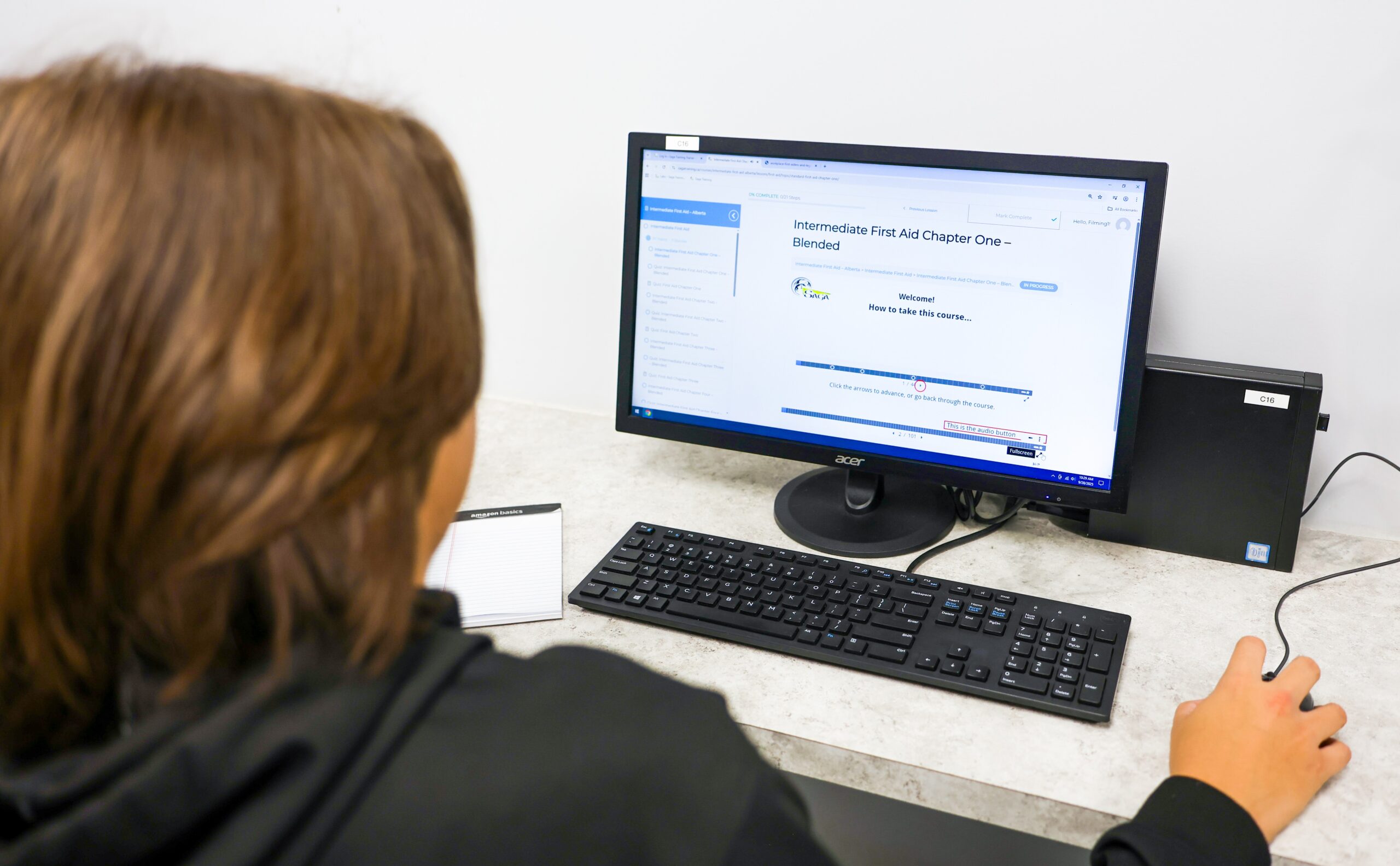
Blended first aid training isn’t a shortcut. It’s a structured delivery format where theory instruction is separated from practical skills work, allowing workers to complete the knowledge-based portion of a course online before an in-person session is attended. For the Intermediate (Standard) First Aid course in Alberta, that means approximately 5 hours of online theory followed by one full day of hands-on practical training and testing with an approved trainer.
The theory can be done at home, on a lunch break, or between shifts. The practical portion cannot be moved online, and that distinction matters. It’s worth being clear about it from the start.
Why the Two-Part Structure Exists
First aid training has always carried two components: knowing what to do, and being able to do it under pressure. Theory instruction covers the knowledge side. Concepts like airway management, how a medical emergency is recognized, and what spinal precautions look like are all introduced at this stage. That content can be absorbed through reading, video, and online testing.
But performing CPR, managing an unresponsive patient, or stabilizing a suspected spinal injury, those skills need to be practiced and assessed in person. Technique needs to be observed by an approved trainer, errors need to be corrected, and competency needs to be confirmed before a certificate can be issued. No online module can replicate that; so the blended format keeps each component where it belongs.
How the Online Theory Portion Works
The online theory instruction component is typically self-paced, completed before the in-person day begins. Workers move through modules covering Airway Management, Breathing Management, Cardiovascular Emergencies, Medical Emergencies, and Spinal and Neurological Emergencies. A knowledge testing portion is included, and it must be passed before the practical day proceeds.
In many cases, industrial employers across Alberta find this format easier to schedule than a full two-day block. The online portion can be completed across evenings or on a rest day, and workers then attend the practical session as an individual or as a group. Class sizes for the in-person day generally run between 6 and 20 participants; over time, that range has become fairly standard across approved providers.
What Happens During the In-Person Skills Day
The in-person day is where skills are tested, not just reviewed. Participants are led through the practical curriculum by an approved trainer, and each worker is assessed on their ability to demonstrate those skills correctly.
Hands-on work covers CPR, airway management techniques, patient assessment, and responses to medical emergencies. Intermediate (Standard) First Aid also requires additional skills beyond what Basic (Emergency) First Aid covers, even though the core content between the two is, in a way, similar. The practical day is structured so that all of it gets covered and tested. That’s usually where things click for workers who found the theory straightforward but hadn’t yet tried applying it under time pressure.
Basic vs. Intermediate: Knowing Which Course Applies
Basic (Emergency) First Aid is a 1-day, 8-hour course. Foundational emergency response skills are covered, and the course is delivered entirely in person. It isn’t available in blended format.
Intermediate (Standard) First Aid is a 2-day, 16-hour course in a traditional delivery format, or 5 hours online plus 1 full in-person day when the blended format is used. The core content between the two courses is similar, but additional skills are required at the Intermediate level, along with a deeper level of demonstrated competency. For most Alberta construction and industrial worksites, the level of hazard present, the number of workers on shift, and the distance to a healthcare facility will determine which course is required and how many certified first aiders need to be on site.
What Alberta Employers Need to Know About Compliance
Alberta’s occupational health and safety requirements set out clear expectations for workplace first aid training. The number of first aiders required on any given site is determined by the degree of hazard (low, medium, or high), the number of workers present per shift, and proximity to a healthcare facility. These requirements apply to all workplaces, not just construction projects.
Employers are responsible for ensuring that the training program selected is compliant with provincial legislation, meets the most recent CSA standards, meets industry best practices, and follows the principles of adult education. Training providers must appear on the Alberta Approved Training Agencies list. Documented training records and readily available first aid supplies are mandatory for all workplaces. After certification is issued, the training fundamentals are expected to be applied by employers to their specific workplace, so that ongoing worker competency can be maintained.
Reputable Programs and What to Look For
A reputable first aid training course should be explicitly compliant with provincial legislation, follow the most recent CSA standards, meet industry best practices, and meet the principles of adult education. That’s not just a checklist item. The training selected by employers must be able to withstand scrutiny from Occupational Health and Safety Officers, and that responsibility sits with the employer.
The course structure should include a knowledge portion with testing, followed directly by a practical hands-on skill demonstration and testing portion. Both components need to be present. Blended delivery doesn’t change that requirement; it just changes when and where the theory instruction happens. For industrial environments in Alberta where workers may face confined spaces, exposure to hazardous materials, working at height, or powered mobile equipment, the quality of that practical assessment matters considerably. That sounds straightforward on paper, but selecting the right provider still takes some due diligence.
Certificate Validity and Re-Certification Options
First Aid certificates issued in Alberta are provincially recognized and remain valid for not more than 3 years. Basic Life Support CPR carries its own renewal requirements, which differ from the first aid certificate timeline and should be confirmed directly with your training provider.
For workers who currently hold a valid Intermediate (Standard) First Aid certificate, a 1-day re-certification course is available. It’s a practical option for employers managing renewal schedules across a larger workforce. Blended delivery is also available for re-certification in many cases, though the in-person practical skills testing remains a required component regardless of format. Visit wcff.ca to learn more about Intermediate First Aid training and re-certification options available through Western Canada Fire & First Aid.
FAQ
Q: Can the entire Intermediate First Aid course be completed online?
No. The theory instruction portion, approximately 5 hours, can be completed online at your own pace. But the practical skills component must be done in person with an approved trainer. That requirement isn’t flexible. Skills like airway management and CPR need to be physically demonstrated and tested before a certificate is issued. That still surprises people.
Q: Is blended training accepted under Alberta OHS regulations?
Yes. Alberta’s occupational health and safety requirements are aligned with CSA Standard Z1210-17, which supports blended delivery for the Intermediate (standard) First Aid course. Training providers must be listed on the Alberta Approved Training Agencies list to issue valid certificates. Employers are responsible for confirming that any program they select meets provincial legislation, current CSA standards, industry best practices, and the principles of adult education.
Q: What modules are covered in the in-person portion of blended training?
The practical day covers the core curriculum, including Airway Management, Breathing Management, Cardiovascular Emergencies, Medical Emergencies, and Spinal and Neurological Emergencies. Additional skills required at the Intermediate level are also tested in person. Not just reviewed, actually tested. The knowledge portion is assessed online, and the practical skills demonstration and testing follow directly from there.
Q: Is there a faster option for workers who already hold a valid Intermediate First Aid certificate?
Yes. A 1-day re-certification course is available for individuals who currently hold a valid Intermediate (standard) First Aid certificate. It’s a more efficient path than repeating the full program, and it keeps workers compliant without pulling them off site for two days. Worth confirming eligibility with your training provider before booking.



0 Comments