First Aid for New Hires: What to Know on Day One
Why Day One Matters More Than People Expect
New workers get hurt more often than experienced ones. That’s not an opinion; it’s a pattern that has been observed by safety professionals across Alberta’s construction and industrial sectors for years. On a busy site, a new hire is trying to absorb a lot at once: where things are, how the crew operates, what the unwritten rules are. First aid awareness tends to get buried under everything else, bit by bit, until it’s simply assumed someone else knows. But knowing where the kit is, who the first aider on shift is, and how to call for help, those basics can make a real difference before an ambulance arrives. Employers carry a legal obligation to communicate that information clearly, and day one is the right time for it to happen.
What Alberta Law Actually Requires
Under Alberta’s occupational health and safety legislation, a minimum number of trained first aiders must be kept available during working hours at every workplace. The exact number isn’t fixed; it depends on the degree of hazard at the site, classified as low, medium, or high, the number of workers present on a given shift, and how far the site sits from a healthcare facility. A remote industrial camp is governed by different requirements than an urban office. Documented training records and readily available first aid supplies are treated as mandatory for all workplaces, not just construction projects. Alberta’s requirements also meet CSA Standard Z1210-17, which helps align certification standards across the country.
Understanding the Two Main Course Options
Two course levels are used most often across Alberta’s industrial and construction sectors. Basic (emergency) First Aid is a 1-day course, running approximately 8 hours. Intermediate (standard) First Aid is a 2-day course totaling 16 hours, though it can also be completed in a blended format: 5 hours of online theory instruction followed by 1 full day of in-person practical skills and testing. Both courses cover similar core content, but additional skills are required at the Intermediate level beyond what Basic includes. The right level for a given worker is determined by the hazard classification of their worksite and the employer’s assessment of what’s needed to meet OHS requirements.
What the Curriculum Actually Covers
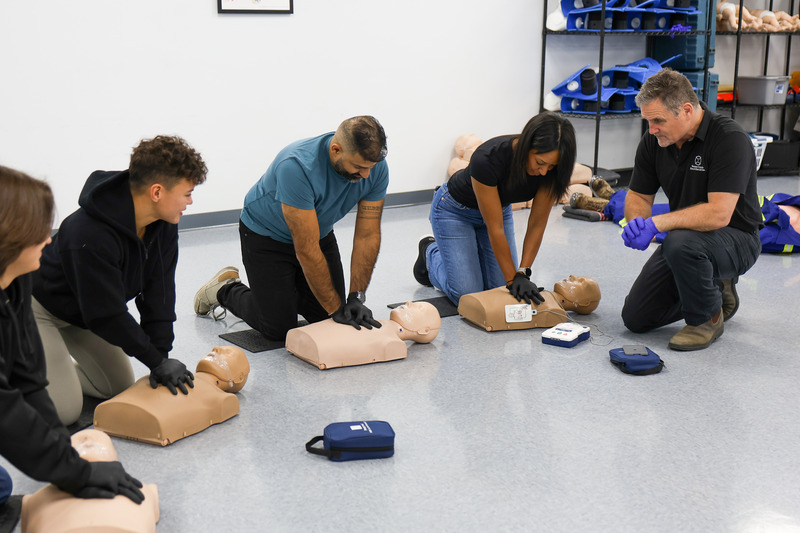
An approved First Aid Training course must be compliant with Provincial Legislation, meet the most recent CSA standards, meet Industry Best Practices, and follow the Principles of Adult Education. That’s not just a quality marker; it’s what needs to be confirmed by employers before workers are enrolled. The curriculum typically includes modules on Airway Management, Breathing Management, Cardiovascular Emergencies, Medical Emergencies, and Spinal and Neurological Emergencies, among others. A knowledge portion with testing must be encompassed in the training, followed directly by a practical hands-on skill demonstration and testing portion. Theory instruction alone isn’t enough. After certification is issued, those fundamentals are expected to be applied by employers to their specific workplace, so that genuine worker competency is built in context. Interesting how that works, in a way.
Choosing the Right Training Provider
Not every training provider is equal, and the responsibility for vetting them is held by the employer. Training providers must appear on the Alberta Approved Training Agencies list, which is maintained by Alberta OHS, and this should be confirmed before any course is booked. Compliance with Alberta’s occupational health and safety laws is required for the training course itself; employers must also ensure their chosen program meets requirements that would withstand scrutiny from an Occupational Health and Safety Officer. That sounds straightforward on paper, but gaps in provider selection do show up during audits. Classes are typically run with 6 to 20 participants, which allows for the kind of hands-on practice that actually builds skill. First aid certifications issued in Alberta are provincially recognized.
Industrial Worksites Have Additional Considerations
Construction and industrial environments carry hazards that go well beyond what a standard office might face. Working at height, powered mobile equipment, confined spaces, and exposure to hazardous materials all create scenarios where first aid response needs to be faster and more specific. In many cases, workers in these environments are required to hold Intermediate (Standard) First Aid rather than Basic First Aid, simply because the risk profile demands it. Workplace Safety training in these sectors is often run alongside other required programs, and new hires may find themselves completing multiple courses in their first weeks. That’s not unusual. It reflects the reality of the environment they’re walking into, over time becoming part of how the site operates.
Recertification and Keeping Records Current
First aid certificates are valid for up to 3 years. A 1-day recertification course can be completed by workers who hold a valid Intermediate (standard) First Aid certificate when renewal time arrives, rather than repeating the full 2-day program. Basic Life Support CPR carries its own renewal requirements, kept separate from the standard first aid certificate, so both timelines should be tracked independently. Documented training records are treated as a mandatory requirement for all workplaces in Alberta, and keeping those records current is the employer’s responsibility. That’s usually where compliance gaps are found during inspections; not in the training itself, but in the paperwork.
Getting Your Team Trained Through Western Canada Fire & First Aid
For construction and industrial employers in Alberta, getting new hires trained through a qualified provider is one of the more straightforward compliance steps available. First Aid Training courses and CPR Training courses are offered by Western Canada Fire & First Aid, designed to meet provincial requirements and CSA Standard Z1210-17. Whether your team needs Basic (emergency) First Aid, Intermediate (standard) First Aid, or a recertification option for workers with a current certificate, the right program is available. Visit our website at wcff.ca to learn more about course options, scheduling, and how to get your workforce properly trained from day one.
FAQ
Q: Does every new hire in Alberta need to complete a First Aid Training course before starting work?
Not necessarily on their literal first day, but first aid training is treated as a mandatory requirement under Alberta’s occupational health and safety legislation for most workplaces. A sufficient number of trained first aiders must be kept present on every shift, and that responsibility is held by the employer. New hires working in construction or industrial environments are often expected to complete Intermediate (Standard) First Aid within a defined period of starting. Worth knowing early.
Q: What’s the difference between Basic and Intermediate First Aid in Alberta?
Both courses cover similar core content, including Airway Management, Breathing Management, Cardiovascular Emergencies, Medical Emergencies, and Spinal and Neurological Emergencies. The core content is shared, but Intermediate (Standard) First Aid requires additional skills beyond what Basic First Aid covers, making it the appropriate level for higher-hazard worksites. Basic (emergency) First Aid is completed in 1 day (8 hours); Intermediate (standard) First Aid takes 2 days (16 hours) in full, or it can be taken in a blended format with 5 hours of online theory instruction followed by 1 day of in-person practical skills and testing. That still surprises people.
Q: How long does a first aid certificate last in Alberta?
A first aid certificate is valid for not more than 3 years from the date of issue. Basic Life Support CPR has its own renewal requirements, which are kept separate from the Intermediate (standard) first aid certificate timeline, so both should be confirmed when recertification is being planned. A 1-day recertification course is available to individuals who currently hold a valid Intermediate (standard) First Aid certificate, rather than requiring the full program to be repeated. Convenient, and it keeps training disruption to a minimum.
Q: Can theory instruction for first aid be completed online?
Yes, the theory instruction component can be completed online or in a classroom setting, depending on the course format. However, all hands-on practical skills must be demonstrated in person with an approved trainer. No exceptions there. After certification is issued, the training fundamentals are expected to be applied by employers to their specific workplace, so that worker competency is confirmed in real conditions.



0 Comments