What’s Included in Certified Forklift Training in Alberta
Why Forklift Training Is Required in Alberta
Alberta’s occupational health and safety legislation is direct on this point: operators must be properly trained before working with powered mobile equipment. This applies across industries, from construction sites in Calgary to warehouse operations in Edmonton. It’s not a recommendation. Workers are expected to be trained by their employers, and that training must comply with Alberta’s occupational health and safety laws. Documented training records are mandatory for all workplaces, not just large industrial operations. From what we’ve seen, some employers still treat this as a formality, which tends to create problems when an OHS Officer shows up.
How Long Does Training Take for a New Operator
For a new operator learning the basics, proper forklift training typically runs 6 to 8 hours, though timing ultimately depends on the operator’s skill level. Someone with prior experience handling powered mobile equipment may move through the material more quickly; someone stepping onto a forklift for the first time will likely need the full duration, and possibly more time during the practical session. The training is structured in two parts: a theory instruction portion with knowledge testing, followed directly by a hands-on practical skill demonstration and testing portion. Both portions must be completed before certification is issued.
What Theory Instruction Covers
Theory instruction is where foundational knowledge gets built, and it’s what new operators carry onto the floor with them. Topics typically include Alberta’s workplace safety laws, equipment types and their differences, load capacity and stability, pre-operation awareness, and the specific hazards associated with powered mobile equipment. Workplace-specific risks are also addressed, including working at height, confined spaces, and exposure to hazardous materials. A knowledge test is included in the theory portion. Operators are expected to demonstrate that the material has been understood before moving to the practical component. In many cases, this part of the course is what separates operators who work safely over time from those who rely on habit alone.
What the Hands-On Practical Session Includes
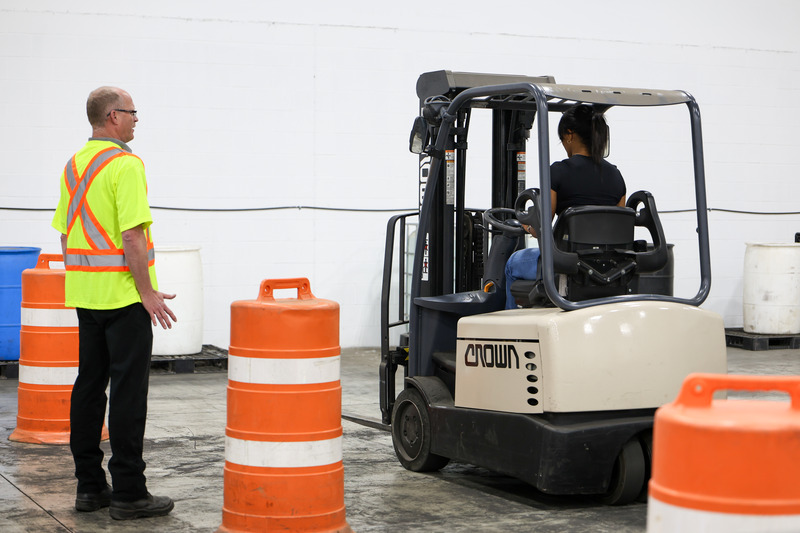
After theory instruction and testing, operators move into the hands-on component, where skills are applied and tested under supervision. The practical session covers basic operation, maneuvering, load handling, and stacking. Operators are assessed on how they handle the equipment, not just whether they can move it from point A to point B. Testing is built into this session. It’s worth noting that theory instruction can be completed online in some programs, but all hands-on practical skills must be demonstrated to an approved trainer. No exceptions; that requirement exists for a reason.
Equipment Types Covered in Training
Certified forklift training in Alberta is generally designed around the types of equipment operators will actually use on site. Counterbalance forklifts are the most common, but narrow-aisle reach trucks and powered pallet jacks are often included as well. The specific equipment covered should match the workplace, which is part of why training providers must be approved by employers before workers are sent to a course. A program built around warehouse equipment may not adequately prepare an operator for a construction site environment. Over time, that’s usually where it clicks for employers who are building out their safety programs for the first time.
What Certification Means After Training Is Complete
Once proper training has been completed, the responsibility for safe operation becomes shared between the worker and the employer. Training fundamentals are expected to be applied to the specific workplace to ensure worker competency. Proper training confirms that an operator has met a standard; it doesn’t automatically mean they’re ready for every task in every environment. Operators who are involved in a forklift incident, or who have been away from forklift work for an extended period, should complete full retraining. Initial worker training doesn’t expire the need to stay current with workplace-specific practices, its on-going throughout the workers career.
What to Look for in a Compliant Training Provider
Not every forklift training course meets Alberta’s requirements, and that distinction matters. Reputable courses must be compliant with Provincial Legislation, meet the most recent CSA standards, meet Industry Best Practices, and follow the Principles of Adult Education. Compliance with Alberta’s occupational health and safety laws is required for the training course. Training providers must be approved by employers, and the program should be able to withstand scrutiny from Occupational Health and Safety officers. Cost generally ranges from $150 to $400, with the price varying depending on a forklift operator’s skill level. Cheaper isn’t always better; in most cases, the quality of the practical testing component is what separates a solid program from a weak one.
Where Western Canada Fire & First Aid Fits In
Workplace safety training in Alberta covers more ground than most employers initially expect. Forklift Training is one piece of a broader compliance picture that also includes First Aid Training courses, CPR Training courses, and, to be fair, workplace-specific safety programs for industries like construction and heavy industry. At Western Canada Fire & First Aid, the focus is on helping businesses build training programs that meet regulatory requirements and actually prepare workers for what happens on site. Visit our website to learn more about available workplace safety training options and to find the right course for your team.
FAQ
Q: Does forklift training in Alberta cover multiple equipment types?
Yes. Most certified training programs are designed to address more than one type of powered mobile equipment. Counterbalance forklifts, narrow-aisle reach trucks, and powered pallet jacks are commonly included, though the specific equipment covered will depend on the course and the workplace. Training providers must be approved by employers to ensure the equipment types match what operators will actually use on site. That still surprises people.
Q: Is a driver’s license required to operate a forklift in Alberta?
No, an Alberta driver’s license is not a legal requirement for operating a forklift unless operating on public roadways. That said, holding one does help workers understand basic vehicle controls like pedals, steering wheels, and seat belts, which can make the practical portion of training easier to absorb. The legal requirement is proper training, not a license.
Q: Who is responsible for approving forklift training providers in Alberta?
Employers must approve training providers. It’s not enough to send workers to any available course. The training must comply with Alberta’s occupational health and safety laws, and the program is expected to withstand scrutiny from Occupational Health and Safety Officers. Documented records of completed training are required for all workplaces.
Q: What happens if an operator is involved in a forklift incident on site?
Full retraining is recommended. Operators who are involved in a forklift incident, or who have been away from forklift operation for an extended period, cannot simply return to work without completing the training process again. Both the theory instruction and the hands-on practical testing must be repeated. A reasonable precaution, given what’s at stake.

0 Comments