First Aid Training for Alberta Construction Crews
What Alberta’s OHS Rules Actually Require from Construction Employers
Clear expectations for workplace first aid are set out in Alberta’s Occupational Health and Safety legislation, and construction sites tend to be among the most closely scrutinized environments when OHS Officers make their rounds. Every employer, regardless of industry, is required to maintain documented training records and ensure first aid supplies are kept readily available on site. For construction and industrial operations, those requirements tend to run more demanding, because the hazard classification is typically higher.
Three things determine how many certified first aiders are required on any given site: the degree of hazard, rated as low, medium, or high; the total number of workers present per shift; and how far the site sits from the nearest healthcare facility. A remote northern Alberta project with a large crew and a high hazard rating will need more first aiders than a small urban renovation job, and that distinction matters when crew training is being planned before a project gets underway.
Basic vs. Intermediate First Aid: Choosing the Right Course Level
Intermediate (Standard) First Aid is most commonly required for construction and industrial workers in Alberta. Basic (Emergency) First Aid may be required for low hazard office workers.
Basic (emergency) First Aid is a 1-day course running approximately 8 hours. Foundational response skills are covered, and it’s generally suited to lower-hazard environments or smaller crews. Intermediate (standard) First Aid runs 2 days and totals 16 hours. The core content is similar between the two levels; Intermediate, though, requires additional skills and a deeper level of demonstrated competency.
For workers who already hold a valid Intermediate certificate, a 1-day re-certification course is available rather than repeating the full program. And for those who prefer some flexibility, Intermediate First Aid can be completed in a blended format: 5 hours of online theory instruction followed by 1 full day of in-person practical skills. No matter how the theory portion is delivered, all hands-on skills must be demonstrated in person with an approved trainer.
What the Curriculum Actually Covers
A well-structured first aid training course goes well beyond basic bandaging. Specific modules are covered in reputable programs, including Airway Management, Breathing Management, Cardiovascular Emergencies, Medical Emergencies, and Spinal and Neurological Emergencies. These aren’t abstract topics on a construction site; a worker who falls from height, for example, may present with spinal concerns that require a very specific response.
A knowledge portion with testing must be included in the training, followed directly by a practical hands-on skill demonstration and testing portion. Both components are required. Theory instruction alone doesn’t satisfy OHS requirements, and a certificate issued without a verified practical component wouldn’t hold up under investigation.
After certification is issued, employers are expected to take the training fundamentals and apply them to their specific workplace. That means thinking through site-specific hazards, reviewing emergency response procedures, and confirming that certified workers are positioned appropriately across shifts. Interesting how that last part often gets left until after the paperwork is filed.
How to Find an Approved Training Provider in Alberta
Not every first aid course offered in Alberta meets the provincial standard. First Aid training providers must appear on the Alberta Approved Training Agencies list, which is maintained by Alberta OHS; that list exists for a reason, filtering out programs that don’t meet the required benchmarks.
Reputable courses are expected to be compliant with Provincial Legislation, meet the most recent CSA standards, meet Industry Best Practices, and follow the Principles of Adult Education. Alberta’s regulations also align with CSA Standard Z1210-17, which helps harmonize certification requirements across Canada, so workers moving between provinces carry credentials that are more broadly recognized.
Training providers must be approved by employers before crews are enrolled. That responsibility sits with the company, not with the training organization itself. Choosing a provider simply because they’re available or affordable, without verifying their standing on the approved list, creates a compliance gap that an OHS Officer will likely find. That sounds reasonable on paper, but it’s a step that gets skipped more often than it should.
Class Size, Format, and What to Expect on Training Day
First aid courses in Alberta typically run with 6 to 20 participants. That range supports the kind of hands-on learning that first aid training requires; too large a group, and the practical components become difficult to manage properly.
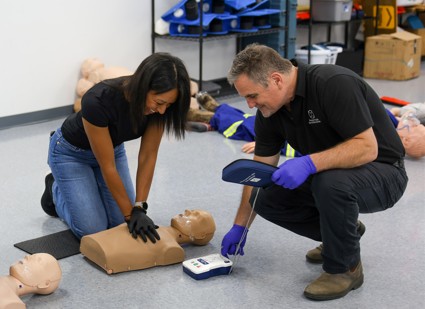
Theory instruction can be delivered in a classroom setting or, for Intermediate First Aid, partially online through the blended format. Either way, the in-person practical session is non-negotiable. Skills are expected to be demonstrated by workers, not just described. That’s where the testing piece matters most, in a way.
From a scheduling standpoint, construction employers often find it easier to bring training on site rather than sending crews off site during active project phases. In many cases, group sessions at the worksite can be accommodated by approved providers, which reduces downtime and keeps the training context relevant to the actual environment workers are operating in.
Site-Specific Hazards That Shape Training Needs
A range of hazards is present on construction and industrial sites in Alberta that go well beyond what a general workplace might encounter. Working at height, operating powered mobile equipment, entering confined spaces, and handling chemical exposure are all scenarios that influence both the required training level and the number of first aiders needed on shift.
A crew working on a high-rise frame in Edmonton faces different risks than a team doing underground utility work or managing chemical storage at an industrial facility. The hazard classification assigned to a worksite, whether low, medium, or high, directly affects the regulatory requirements that apply. Employers who misclassify their hazard level, often unintentionally, may find themselves short on trained personnel when an incident occurs.
Workplace safety training that accounts for these specific conditions tends to produce better outcomes than generic programs. Workers who’ve practiced responding to scenarios that match their actual environment are more likely to act effectively under pressure. Over time, that’s usually where it clicks for most crews.
Keeping Certifications Current and Records in Order
First aid certifications issued in Alberta are provincially recognized and remain valid for not more than 3 years. Basic Life Support CPR carries its own annual renewal requirements, which should be tracked separately and confirmed when scheduling training. Mixing up those timelines is a common administrative error; it can leave a site technically out of compliance even when employers believe their records are current.
Documented training records are mandatory for all workplaces. Copies of certificates must be kept, expiry dates should be tracked, and re-certification needs to be scheduled before credentials lapse rather than after. For larger construction operations with rotating crews, a simple tracking system, even a spreadsheet, goes a long way toward staying organized. Sometimes the simplest systems hold up the best.
Workers who hold a valid Intermediate (standard) First Aid certificate can renew through a 1-day re-certification course. That’s a meaningful time saving compared to repeating the full 2-day program, and it’s worth factoring into annual training budgets.
Getting Your Crew Trained Through Western Canada Fire & First Aid
For construction and industrial employers in Alberta, getting the right first aid training in place is both a compliance requirement and a practical necessity. The combination of remote sites, high-hazard work, and variable crew sizes means a one-size approach rarely fits. Choosing the correct course level, verifying your provider is on the Alberta Approved Training Agencies list, and keeping documentation current are the three things that tend to matter most when an OHS Officer arrives.
Western Canada Fire & First Aid supports businesses across Alberta with workplace safety training that meets provincial requirements and reflects the realities of industrial and construction environments. Whether your crew needs Basic (emergency) First Aid, Intermediate (standard) First Aid, or a CPR Training course to round out their credentials, the right program is available.
Visit our website at wcff.ca to learn more about available courses and to get your team properly trained.
FAQ
Q: What is the difference between Basic and Intermediate First Aid in Alberta?
Both course levels cover similar core content, including airway management, breathing management, cardiovascular emergencies, spinal and neurological emergencies, and medical emergencies. The difference is that Intermediate (Standard) First Aid requires additional skills and runs 16 hours across 2 days, while Basic (Emergency) First Aid is completed in 8 hours over 1 day. All hands-on practical skills must be demonstrated in person with an approved trainer, regardless of which level is taken.
Q: How long does an Alberta first aid certificate last, and when does it need to be renewed?
A standard first aid certificate is valid for 3 years. Workers who hold a valid Intermediate (standard) First Aid certificate can complete a 1-day re-certification course rather than repeating the full program. Basic Life Support CPR has its own renewal requirements, which should be confirmed separately when scheduling training. Worth checking both timelines at once, to be fair.
Q: Who is responsible for making sure first aid training meets OHS requirements?
Training agencies or providers must ensure their first aid program meets OHS requirements. The training program must be compliant with Provincial Legislation, meet the most recent CSA standards, meet Industry Best Practices, and follow the Principles of Adult Education. Employers carry the responsibility of choosing an approved training agency, and training providers must appear on the Alberta Approved Training Agencies list.
Q: Does first aid training need to include a written test?
Yes. Reputable first aid training courses include a knowledge portion with testing, as well as a practical hands-on skill demonstration and testing portion. Theory instruction alone isn’t sufficient. After certification is issued, employers are expected to apply the training fundamentals to their specific workplace to ensure ongoing worker competency.



0 Comments