What’s Included in a CSA Z1210-17 First Aid Training Course
What CSA Standard Z1210-17 Actually Requires
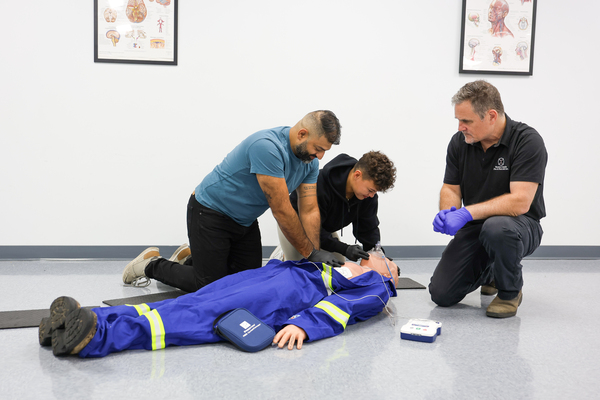
CSA Standard Z1210-17 is the national standard that governs first aid training in Canadian workplaces. Alberta adopted it to bring provincial requirements in line with a consistent, Canada-wide framework. In practical terms, any First Aid Training course delivered to Alberta workers must be structured in a specific way: a knowledge portion with testing comes first, and it is followed directly by a practical hands-on skill demonstration and testing portion. Theory instruction can be completed online or in a classroom setting, while the hands-on component must always be finished in person with an approved trainer. No exceptions. That structure is, in a way, what separates a compliant course from one that simply covers the material.
The Two Course Levels and What They Cover
Two course levels are recognized under Alberta’s first aid requirements. Basic (Emergency) First Aid runs for approximately 8 hours across a single day. Intermediate (Standard) First Aid is spread over two days, totalling approximately 16 hours. Both levels address the same core curriculum areas, including Airway Management, Breathing Management, Medical Emergencies, Cardiovascular Emergencies, and Spinal and Neurological Emergencies, though the depth required differs considerably. Intermediate certification demands additional skills beyond what Basic covers, so the competency expected from an Intermediate-certified worker is meaningfully greater. From what we’ve seen, employers in higher-hazard industries, including construction and industrial operations, will generally find that Intermediate is the more appropriate level for their sites.
The Blended Format Option for Intermediate First Aid
Intermediate (Standard) First Aid can be completed in a blended format, which is worth knowing if scheduling constraints are a concern for your team. In this format, 5 hours of online theory instruction are completed before a full day of in-person practical skills training is attended. The online component is not a shortcut; it replaces the first day of in-class theory instruction and must be finished before the in-person day begins. All practical skill demonstrations and testing are still conducted in person with an approved trainer. Class sizes for compliant courses range from 6 to 20 participants, which keeps the hands-on portions manageable and ensures proper attention is given to each participant during skills testing. Probably enough structure to keep things running smoothly.
Re-Certification and Certificate Validity
First Aid certificates issued under CSA Standard Z1210-17 are valid for 3 years and are provincially recognized across Alberta. For individuals who currently hold a valid Intermediate (Standard) First Aid certificate, a 1-day re-certification course is available, rather than repeating the full 2-day program. It is a practical option; workers are kept current without being pulled off site for longer than necessary. Basic Life Support CPR carries its own renewal requirements, separate from the 3-year first aid certificate, so both timelines should be confirmed when training is being scheduled for a team. Over time, keeping those records current becomes one of the more routine parts of site compliance, though it is no less mandatory for being routine.
How Many First Aiders Does Your Site Actually Need?
This question comes up often in Alberta’s construction and industrial sectors, and the answer is shaped by three factors: the degree of hazard at the worksite, classified as low, medium, or high; the number of workers present on shift; and the distance from the site to the nearest healthcare facility. A remote industrial site with high-hazard work and a large crew will require more certified first aiders than a small office with low-hazard tasks. These factors must be assessed by the employer, and adequate coverage must be maintained. That sounds straightforward on paper, but in practice, sites with shifting crew sizes and variable hazard levels need to revisit those calculations more often than many employers expect. Interesting how that works.
Industrial-Specific Considerations for Construction and Heavy Industry
Alberta’s construction and industrial workplaces carry risks that go well beyond general first aid scenarios. Hazards related to working at height, powered mobile equipment, confined spaces, and chemical exposure are commonly encountered in these environments. These are not covered as separate training modules within a first aid course, but they shape the context in which first aid skills will actually be applied in the field. First aiders in these settings need to understand how site-specific hazards affect emergency response. After certification is issued, the training fundamentals are expected to be taken by the employer and applied to the specific workplace, so that worker competency, to be fair, reflects the actual conditions on the ground.
What Makes a Training Provider Compliant
Not every training provider meets the standard. In Alberta, first aid providers must appear on the Alberta Approved Training Agencies list, which is maintained by Alberta OHS. Beyond that listing, reputable courses are expected to be compliant with Provincial Legislation, meet the most recent CSA standards, meet Industry Best Practices, and follow the Principles of Adult Education. Compliance with Alberta’s occupational health and safety laws is required for the training course itself. Training providers must be approved by employers, who also carry the responsibility of confirming that the program will hold up under review by an Occupational Health and Safety Officer. The onus sits with the employer, not just the provider, and that is generally where the accountability lands for safety managers.
Putting It Together for Your Workplace
Selecting the right first aid training comes down to understanding the site’s hazard level, the workforce size, and which course level meets the applicable regulatory obligations. Basic (Emergency) First Aid suits lower-hazard environments with smaller teams. Intermediate (Standard) First Aid is generally the right fit for construction sites, industrial operations, and any workplace where the risk profile is higher. Both levels must be delivered by a provider on the Alberta Approved Training Agencies list, and both must include tested theory instruction followed by in-person practical skills testing. Western Canada Fire & First Aid supports businesses across Alberta in meeting these requirements with workplace safety training built around real industry needs. Visit our website at wcff.ca to learn more about available course options and to find the right fit for your team.
FAQ
Q: Does CSA Standard Z1210-17 apply to all Alberta workplaces, or just construction sites?
It applies to all workplaces in Alberta, not just construction. The standard was adopted to align provincial requirements with a national framework, which means industrial sites, warehouses, and office environments are all expected to meet the same training benchmarks. Documented training records and readily available first aid supplies are mandatory across the board. That still surprises people.
Q: What is the difference between Basic (emergency) First Aid and Intermediate (standard) First Aid?
Both courses cover the same core content areas, including Airway Management, Breathing Management, Cardiovascular Emergencies, Medical Emergencies, and Spinal and Neurological Emergencies. The difference is depth. Intermediate (Standard) First Aid requires additional skills beyond what Basic covers, and it runs for 16 hours across two full days. Basic runs for 8 hours in a single day. Same foundation, more to demonstrate.
Q: Can the theory instruction for Intermediate First Aid be completed online?
Yes. Intermediate (Standard) First Aid is available in a blended format, where participants complete approximately 5 hours of online theory instruction before attending a full day of in-person practical skills training and testing. The online portion is not optional or supplementary; it replaces the first day of in-class theory. But the hands-on component cannot be done remotely. An approved trainer must be present for all practical skill demonstrations and testing.
Q: How do employers know if a first aid training provider is compliant?
Employers must ensure their chosen first aid provider appears on the Alberta Approved Training Agencies list, which is maintained by Alberta OHS. Reputable courses must be compliant with Provincial Legislation, meet the most recent CSA standards, meet Industry Best Practices, and follow the Principles of Adult Education. After certification is issued, employers are expected to take the training fundamentals and apply them to their specific workplace to ensure worker competency. The responsibility for evaluating programs sits with the employer; training records must be able to withstand scrutiny from Occupational Health and Safety Inspectors.



0 Comments