Working at Height Training Alberta: What Employers Must Know
What Alberta Law Actually Requires for Working at Height
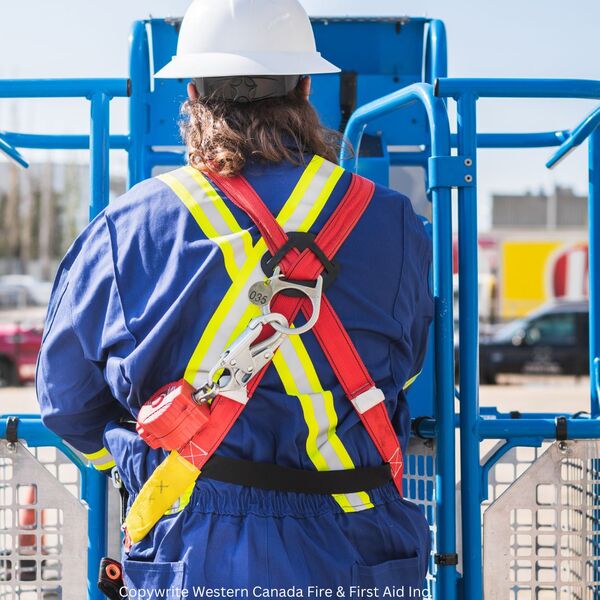
Alberta’s OHS legislation is direct on this point: any worker who could be exposed to a fall hazard must be trained before starting that work. The threshold that triggers a written fall protection plan is a potential fall of 3 metres or more, or a fall into a hazardous substance or moving equipment, regardless of the height. So it’s not just about tall buildings. A worker on a mezzanine level in an industrial facility, or on a raised platform during equipment maintenance, is subject to the same rules. A site-specific fall protection plan is expected to be developed by employers, appropriate equipment must be provided, and workers need to know how to use it correctly. That’s the baseline.
Fall Protection Training: What It Must Include
Training for working at height isn’t just a quick orientation. Fall hazard identification needs to be covered, along with the selection and proper use of fall arrest systems, travel restriction systems, and restraint systems. Workers also need to understand how to inspect their equipment before use and what to do in a rescue situation. Theory instruction can be delivered in a classroom or online setting, but all hands-on practical skills must be demonstrated in person with a competent trainer. That distinction matters. An OHS Inspector reviewing your records will want to see that practical skills were actually tested; not just that a worker watched a video.
First Aid Requirements That Apply Alongside Height Work
Working at height is classified as a high-hazard activity in most Alberta workplaces, and that classification affects first aid requirements. Three factors determine how many certified first aiders are required on site: the degree of hazard (low, medium, or high), the number of workers present on a given shift, and the distance from the worksite to the nearest healthcare facility. Remote industrial sites, in many cases, require more first aiders simply because emergency response times are longer. These factors need to be assessed carefully by employers. First aid supplies must also be readily available, and that requirement applies to all workplaces, not just construction projects.
Basic vs. Intermediate First Aid: Which One Applies to Your Crew
Alberta recognizes two primary first aid levels relevant to most construction and industrial settings. Basic (Emergency) First Aid is a 1-day, 8-hour course. Intermediate (Standard) First Aid is a 2-day, 16-hour course. The core content is similar across both, but additional skills are required at the Intermediate level, and it is generally required for higher-hazard environments. Modules covered include Airway Management, Breathing Management, Cardiovascular Emergencies, Medical Emergencies, and Spinal and Neurological Emergencies, among others. Intermediate First Aid can also be taken in a blended format, with 5 hours of online theory instruction followed by 1 full day of in-person practical skills. For those who already hold a valid Intermediate certificate, a 1-day re-certification course is available.
Choosing a Training Provider That Meets Alberta Standards
Not every training provider is equal, and the responsibility of making sure selected programs will hold up under OHS scrutiny falls on employers. Training providers must appear on the Alberta Approved Training Agencies list, which is maintained by Alberta OHS. Beyond that, reputable courses need to be compliant with Provincial Legislation, meet the most recent CSA standards, meet Industry Best Practices, and follow the Principles of Adult Education. Alberta’s first aid regulations also align with CSA Standard Z1210-17, which helps harmonize certification across Canada. A knowledge portion with testing must be included in training, followed directly by a practical hands-on skill demonstration and testing portion. Employers must approve training providers; that responsibility sits with the company.
After Training Is Issued: The Employer’s Ongoing Role
Receiving a certificate doesn’t end the employer’s obligation. Once certified training is completed, the training fundamentals are expected to be taken by employers and applied to their specific workplace, to ensure ongoing worker competency. That means site-specific orientation, regular equipment checks, and making sure workers are actually applying what they learned. Documentation can be requested by OHS Inspectors at any time, and employers need to be prepared. Training records must be kept current and accessible. Anyway, that’s usually where it clicks for most site supervisors: the training is the foundation, but the employer builds the rest.
Other High-Hazard Training That Often Applies in the Same Workplaces
Working at height rarely exists in isolation. Many Alberta construction and industrial sites also require workers to be trained in confined space entry, chemical exposure awareness, and powered mobile equipment operation. Workplace safety training that addresses multiple hazards at once tends to be more practical for employers managing crews across different tasks. A worker on a large industrial site might need fall protection training, first aid coverage, and equipment-specific instruction, all documented and current. From what we’ve seen, the worksites that manage this well treat training as an ongoing part of operations rather than a one-time checkbox; that approach tends to hold up better when an OHS Officer arrives.
Getting Your Team Compliant: Where to Start
If your crew works at height in Alberta, whether on a construction site, an industrial platform, or anywhere a fall hazard exists, the time to review your training program is before an incident occurs. First aid requirements should be assessed based on hazard level, shift size, and site location. Training records need to be documented and practical skills must have been tested in person. First Aid certifications are provincially recognized and valid for 3 years, so tracking renewal dates is part of the job. Visit our website at wcff.ca to learn more about how Western Canada Fire & First Aid supports construction and industrial employers across Alberta with workplace safety training that meets provincial requirements.
FAQ
Q: Is fall protection training legally required in Alberta? Yes. Alberta’s OHS legislation requires that workers be trained in fall protection before they perform any work where a fall hazard exists. That training must be documented. Required before the work starts, not after. That still surprises people.
Q: What does fall protection training typically cover? Good question. Training generally includes fall hazard identification, selection and use of fall protection equipment, inspection of that equipment, and emergency rescue requirements. The theory instruction portion is followed directly by a hands-on practical skills demonstration and testing component. All practical skills must be completed in person with an approved trainer, even if theory is done online.
Q: Does fall protection training connect to first aid requirements in Alberta? Yes, and the two are often managed together on active worksites. First aid coverage is required by Alberta OHS based on hazard level, number of workers on shift, and distance to a healthcare facility. High-hazard environments, which often include work at height, typically require workers trained in Intermediate (Standard) First Aid. Both sets of requirements apply to all workplaces.
Q: How often does fall protection training need to be renewed in Alberta? Renewal timelines can vary depending on the specific training and employer policy, but in general, training records should reflect current competency. First Aid certifications, which are provincially recognized, are valid for 3 years. Employers are responsible for ensuring workers remain competent and that training records can withstand scrutiny from OHS Officers.


0 Comments