First aid for warehouse workers: how to prepare teams for everyday injuries

Why Warehouse Injuries Deserve a Specific Response Plan
Warehouses aren’t all the same. Some handle chemicals; some run forklifts around the clock. Others involve workers operating at height or moving through confined spaces, where the margin for error is considerably smaller. Each of those environments produces a different injury profile, and a generic first aid plan often falls short when something actually happens. In Alberta’s industrial sector, from distribution centres to manufacturing facilities, the range of everyday injuries includes lacerations, musculoskeletal strains, chemical splashes, and crush injuries near powered mobile equipment. What a team is likely to face should be understood before a response plan is built, not after.
Understanding Alberta’s First Aid Requirements
Alberta’s workplace first aid requirements are governed by occupational health and safety legislation and are aligned with CSA Standard Z1210-17, which was designed to harmonize certification standards across Canada. The number of certified first aiders required on any given site isn’t a flat number. Three factors are considered: the degree of hazard, classified as low, medium, or high; the number of workers present on shift; and the distance to the nearest healthcare facility. A remote industrial site with 30 workers and high-hazard conditions will be assessed very differently than a small urban warehouse, and the requirements will reflect that. One-size approaches, in a way, tend not to hold up well under scrutiny.
Basic vs. Intermediate First Aid: What’s the Difference
Basic (emergency) First Aid is a 1-day course, running approximately 8 hours. Intermediate (standard) First Aid is a 2-day course at 16 hours total. Similar core content is covered in both programs, including modules on Principles of Workplace First Aid, Management of Injured/ill workers, Airway Management, Breathing Management, Circulation Management, Injury Management, Medical Emergencies, Transportation Management and Spinal and Neurological Emergencies. The distinction is that additional skills are required to be demonstrated under the Intermediate program, beyond what Basic covers. For many Alberta industrial workplaces, Intermediate is the more appropriate level. Both certifications are provincially recognized and valid for 3 years, though Basic Life Support CPR carries its own separate renewal timeline of 1 year, and that should be tracked independently.
The Blended Option and Re-Certification
Not every worker can take two consecutive days off the floor. That’s a real operational constraint, and the blended format for Intermediate (standard) First Aid was developed to address it. Five hours of theory instruction are completed online, followed by one full day of in-person practical skills. The theory portion can be worked through at the worker’s own pace; the hands-on component, however, must be completed with an approved trainer in person. There’s no way around that requirement. Over time, re-certification also needs to be factored in: workers who currently hold a valid Intermediate First Aid certificate can access a 1-day re-certification course rather than repeating the full program. That’s a practical option worth building into any scheduling plan, I suppose.
What Good First Aid Training Actually Looks Like
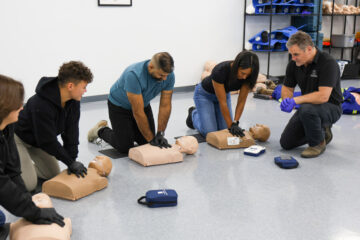
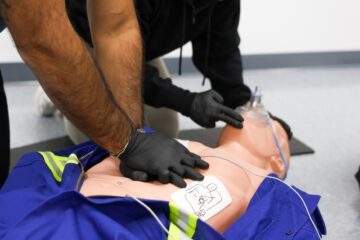
A reputable First Aid Training course needs to be compliant with Provincial Legislation, follow the most recent CSA standards, meet Industry Best Practices, and meet the Principles of Adult Education. In practice, that means a knowledge portion with testing must be included, followed directly by a practical hands-on skill demonstration and testing portion. Theory instruction alone isn’t enough. Skills need to be performed, not just described. Classes are run between 6 and 20 participants, which keeps the hands-on component manageable for everyone involved. After certification is issued, the training fundamentals are expected to be applied by employers to their specific workplace, confirming worker competency under real conditions.
Industrial Hazards That Require Specific Preparation
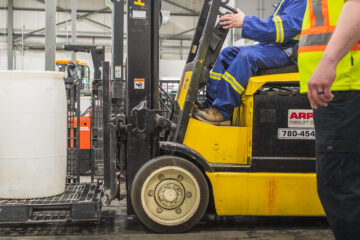
Warehouse and industrial environments in Alberta often involve hazards that go well beyond standard first aid scenarios. Working at height, operating powered mobile equipment, entering confined spaces, and handling chemical substances all create injury risks that require workers and first aiders to be specifically prepared. A worker who falls from an elevated platform may have a spinal injury; a chemical splash requires a different immediate response than a laceration does. First aiders in these environments should understand how to manage those scenarios, and Workplace Safety training should be reviewed by employers to reflect the actual hazards present on site, not just a general curriculum pulled from a shelf.
Compliance Isn’t Optional: Records, Supplies, and Accountability
Documented training records and readily available first aid supplies are mandatory for all Alberta workplaces. That applies to warehouses, distribution centres, and industrial facilities, not just construction projects. Records need to be kept current and accessible, particularly if an OHS Officer visits the site. The training that’s been selected must meet requirements and hold up under that scrutiny; that evaluation falls to the employer. Providers must appear on the Alberta Approved Training Agencies list maintained by Alberta OHS, and compliance with Alberta’s occupational health and safety laws is required for any training course used to meet those obligations. Keeping records organized is a straightforward part of the process, though it sometimes gets overlooked until it matters most.
Getting Your Team Properly Prepared
Preparing a warehouse team for everyday injuries is a process, not a one-time checkbox. It starts with the hazard level and worker count being assessed, then the right course being selected, Basic (emergency) First Aid or Intermediate (standard) First Aid, from a provider on the Alberta Approved Training Agencies list. Scheduling needs to fit the operation, whether that’s a standard in-person format or the blended option for Intermediate. And it carries forward through documented records, stocked supplies, and periodic re-certification. Western Canada Fire & First Aid supports industrial and construction businesses across Alberta with workplace safety training built around these requirements. Visit our website to learn more about available courses and how to get your team properly covered.
FAQ
Q: What first aid course is right for a warehouse or industrial site in Alberta?
It depends on the hazard level of the work being done. Basic (emergency) First Aid, an 8-hour single-day course, is often sufficient for lower-hazard environments. Intermediate (standard) First Aid, a 16-hour two-day course, is required where hazard levels are medium to high. Both courses are provincially recognized. The core content is similar between the two, but additional skills are required to be demonstrated under the Intermediate program.
Q: Can Intermediate First Aid be completed online?
Partially, yes. Intermediate (standard) First Aid can be taken in a blended format, which requires 5 hours of online theory instruction followed by one full day of in-person practical skills. Theory can be completed online or in a classroom setting. However, all hands-on practical skills must be demonstrated in person with an approved trainer. No exceptions there.
Q: How do employers know if their first aid training provider is legitimate?
Training providers must appear on the Alberta Approved Training Agencies list, which is maintained by Alberta OHS. Reputable courses need to be compliant with Provincial Legislation, follow the most recent CSA standards, meet Industry Best Practices, and meet the Principles of Adult Education. Employers must ensure the training they select can withstand scrutiny from Occupational Health and Safety Officers. That responsibility sits with the employer, not the provider.
Q: What happens after workers complete their first aid course?
After certified training is issued, employers are expected to take the training fundamentals and apply them to their specific workplace to ensure worker competency. A certificate alone doesn’t close the loop. Employers need to confirm that trained workers understand how to respond to the actual hazards present on their site, whether that involves chemical exposure, working at height, or powered mobile equipment.