Why Documented Training Records Are Mandatory for All Workplaces

What Alberta Law Actually Requires
Alberta’s OHS legislation doesn’t leave much room for interpretation on this point. Workers are required to be trained to perform their work safely, and that training must be documented by the employer. The records need to show what was covered, who completed it, and when. This applies across all industries, from commercial construction sites in Calgary to industrial facilities in Fort McMurray. It’s not a recommendation. It’s a legal baseline, and it is checked for by OHS Officers.
Why “They Were Trained” Isn’t Enough
Verbal confirmation doesn’t hold up during an inspection. Neither does a general statement that workers “went through orientation.” From what we’ve seen, informal acknowledgment is often believed to be sufficient by many employers in the construction and industrial sector, but that assumption tends to create problems quickly. Documentation has to be specific. The course title, the training provider, the date of completion, and the expiry date where applicable should all be included. Without that detail, the record is, in a way, essentially useless.
First Aid Training and the Certification Paper Trail
First Aid certifications are provincially recognized in Alberta and are valid for 3 years. That means records need to reflect not just who holds a certificate, but when it expires and whether renewal has been completed. Basic (emergency) First Aid is an 8-hour, 1-day course. Intermediate (standard) First Aid runs 16 hours over 2 days, though it can also be completed in a blended format, requiring 5 hours of online theory instruction followed by 1 full day of in-person practical skills. A 1-day re-certification course is available for workers who currently hold a valid Intermediate First Aid certificate. All of these need to be tracked individually, per worker, per site; over time, gaps in that tracking tend to surface at the worst possible moment.
Hazard Level Determines How Many Records You Need
The number of certified first aiders required on a worksite isn’t fixed. It depends on the degree of hazard, whether low, medium, or high, the number of workers on shift at any given time, and the distance from the site to an approved healthcare facility. A remote industrial site with high-hazard work and 30 workers on shift will require more certified first aiders than a low-hazard office with 10 employees. Each site needs to be assessed individually by employers, and training records should reflect the correct coverage for each scenario. That sounds straightforward on paper, but in practice it’s often where compliance gaps are found. Interesting how that works.
What Qualifies as Acceptable Training
Not every course meets the standard. Reputable training programs must be compliant with Provincial Legislation, follow the most recent CSA standards, meet Industry Best Practices, and meet the Principles of Adult Education. Alberta First Aid regulations also align with CSA Standard Z1210-17, which helps harmonize certification across Canada. Training providers must be found on the list of approved First Aid Training Agencies provided by Alberta OHS. Employers must approve training providers themselves, and the responsibility for ensuring selected programs can withstand scrutiny from OHS officers rests with the employer. That responsibility doesn’t transfer to the provider.
The Structure of Compliant Training
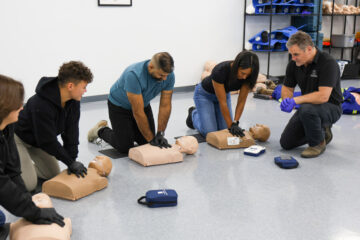
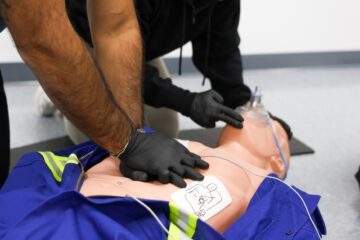
A properly structured course includes two distinct components. First, a knowledge portion with testing, where workers demonstrate they understand the material. Then, directly following, a practical hands-on skill demonstration and testing portion, where proficiency is confirmed in person. Theory instruction can be completed online or in a classroom setting, but all hands-on practical skills must be demonstrated in person with an approved trainer. After certification is issued, those training fundamentals are expected to be regularly applied by employers to their specific workplace, building genuine worker competency. First aid drills should be done at least annually. The certificate is a starting point, not the finish line. That’s usually where it clicks for most supervisors.
Industrial-Specific Training Records That Often Get Missed
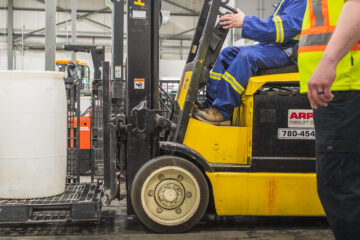
Beyond first aid, training for a range of hazard-specific programs is required to be documented by construction and industrial workplaces across Alberta. Working at height, powered mobile equipment, confined space entry, and chemical exposure training all need to be tracked. Forklift Training records, in particular, are commonly incomplete. Certified training is required before operators are permitted to operate equipment, and records must reflect that. The same applies to workers using narrow-aisle reach trucks or powered pallet jacks. These aren’t optional additions to a safety file; they’re required documentation under Alberta’s OHS framework.
Keeping Records Current and Ready for Review
Records aren’t a one-time task. They need to be updated as certifications are renewed, as new workers are hired, and as job duties change. A worker who moves from a low-hazard role to a high-hazard one may require additional training, and that transition should be reflected in their file. Documentation can be requested by OHS Officers at any time, and it is expected to be produced promptly by employers. Staying organized isn’t complicated, but a consistent process does need to be in place. Visit our website to learn more about how Western Canada Fire & First Aid supports Alberta employers in building and maintaining compliant training programs.
FAQ
Q: Are training records required even if no incidents have occurred?
Yes. The obligation to maintain records exists independent of whether an incident has taken place. Documentation is required by Alberta OHS legislation as an ongoing employer responsibility, not a reactive one. Records are expected to be current and accessible at all times. That still surprises people.
Q – What types of training need to be documented?
Any training that is required under Alberta’s OHS Code must be recorded. That includes Basic (emergency) First Aid, Intermediate (standard) First Aid, CPR Training courses, Forklift Training, and any hazard-specific programs covering confined spaces, chemical exposure, or working at height. Essentially, if the training is required for a worker to safely perform their job, a record of it needs to exist.
Q: How long do training records need to be kept?
Good question. A single universal retention period for all training records has not been set by Alberta OHS, but best practice, and in many cases regulatory expectation, is to keep records for the duration of a worker’s employment and for a reasonable period after. For certifications with defined renewal timelines, records should span at least one full certification cycle.
Q: What happens if an OHS Inspector finds missing records?
A compliance order can be issued by an officer, requiring records to be produced or corrected. Depending on the severity of the gap, fines or stop-work orders may follow. Incomplete records are treated as evidence that training may not have occurred at all, which puts the employer in a difficult position to defend.
0 Comments