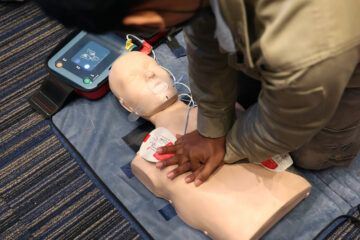
First Aid Training for Oilfield Workers in Alberta

Why Remote Sites Carry a Different Kind of Risk
Distance changes everything in an emergency. At a wellsite two hours from the nearest hospital, a worker with a serious injury from a fall, a chemical exposure, or a cardiac event is depending entirely on the people standing nearby. Emergency services will be called, yes, but they won’t arrive in time to manage those first critical minutes. That window belongs to whoever is on site; it cannot be transferred or delayed. In oilfield operations across Alberta, that reality is what shapes how workplace safety training needs to be planned, not as a checkbox, but as a genuine operational priority.
What Alberta’s OHS Legislation Actually Requires
A single blanket standard for all worksites is not what Alberta’s occupational health and safety legislation sets out. The number of first aiders required on any given site is determined by three factors: the degree of hazard (classified as low, medium, or high), the number of workers present on shift, and the distance to a healthcare facility. Remote oilfield sites, by definition, tend to score higher on all three. That combination typically means more trained workers are needed on site, and that Intermediate (standard) First Aid is required rather than Basic (emergency) First Aid. Over time, employers who plan around those three factors tend to stay ahead of compliance reviews.
Basic vs. Intermediate First Aid: Understanding the Difference
Similar core content is covered by both Basic (emergency) First Aid and Intermediate (standard) First Aid. The distinction is that Intermediate requires additional skills and a significantly longer training commitment. Basic First Aid is a 1-day (8 hours) course; Intermediate First Aid is a 2-day (16 hours) course. Modules such as Airway Management, Breathing Management, Medical Emergencies, and Spinal and Neurological Emergencies are included in the curriculum for both. Intermediate goes further, though, building on those foundations with additional practical requirements that must be tested in person with an approved trainer. For high-hazard remote sites, that added depth matters, and it’s generally where the difference is felt most.
The Blended Format Option and What It Means Practically
A blended format is available for Intermediate (standard) First Aid, which allows 5 hours of theory instruction to be completed online before attending 1 full day of in-person practical skills training. For industrial employers managing scheduling across multiple sites or shifts, this is, in a way, a genuinely useful option. That said, the in-person component is not optional or abbreviated. All hands-on practical skills must be demonstrated and tested with an approved trainer; that standard doesn’t change based on how the theory was delivered. The blended format changes where the theory happens, nothing more. Workers who currently hold a valid Intermediate certificate can also complete a 1-day re-certification course instead of repeating the full program.
Oilfield-Specific Hazards That Shape Training Needs
A specific set of risks is carried by oilfield environments, risks that go well beyond general workplace hazards. Confined space entry, chemical exposure, working at height, and powered mobile equipment all create injury scenarios that require trained responders who know what they’re doing under pressure. More than basic awareness is needed by a worker managing a chemical exposure incident or a spinal injury from a fall. From what we’ve seen, sites that treat first aid training as a formality tend to be the ones least prepared when something actually goes wrong. That’s usually where it clicks for most supervisors, when they start mapping the hazards to the response gaps.
Choosing a Training Provider That Meets the Standard
Not every first aid course carries the same weight. In Alberta, training providers must appear on the Alberta Approved Training Agencies list provided by Alberta OHS. Beyond that, reputable courses must be compliant with Provincial Legislation, follow the most recent CSA standards, meet Industry Best Practices, and meet the Principles of Adult Education. A knowledge portion with testing must be included in the training, followed directly by a practical hands-on skill demonstration and testing portion. Alberta regulations also align with CSA Standard Z1210-17, which harmonizes certification requirements across Canada. Training providers must be approved by employers, and the program must be confirmed to meet those standards before workers are sent through it. That sounds straightforward on paper, but the verification step is one that gets skipped more often than it should. Interesting how that works.
What Compliance Looks Like on the Ground
Compliance is not just about having trained workers on site. Documented training records are mandatory for all workplaces in Alberta, and first aid supplies must be kept readily available at all times. The type and quantity of supplies required will depend on the same hazard, shift size, and distance factors that determine staffing levels. Classes are typically held with 6 to 20 participants, which allows for the kind of hands-on engagement that remote site training genuinely requires. First Aid certifications are provincially recognised, and certificates remain valid for 3 years. Basic Life Support CPR carries its own separate renewal timeline, which should be confirmed directly with the training provider.
Getting Your Team Properly Prepared
For industrial and oilfield employers in Alberta, whether first aid training is required isn’t really the question. It is. The more practical question is whether the training completed by your team is the right level, delivered by an approved provider, and documented in a way that holds up to OHS review. Western Canada Fire & First Aid works with businesses in the construction and industrial sector to make sure that standard is met, not just on paper, but in practice. Visit our website at wcff.ca to learn more about available First Aid Training courses and how to get your remote site teams properly prepared.
FAQ
Q: What level of first aid training is required for workers at remote oilfield sites in Alberta?
The required level depends on a few factors: the hazard classification of the work being done, how many workers are on shift at any given time, and how far the site is from a healthcare facility. For high-hazard remote operations, Intermediate (standard) First Aid is generally expected. That course covers modules including Airway Management, Breathing Management, Medical Emergencies, and Spinal and Neurological Emergencies. Not a light list.
Q: How long does Intermediate First Aid take to complete, and can it be done online?
Intermediate (standard) First Aid is a 2-day (16 hours) course. It can be taken in a blended format, which requires 5 hours of online theory instruction and 1 full day of in-person practical skills with an approved trainer. Theory can be completed online, but all hands-on practical skills must be demonstrated and tested in person. That requirement is non-negotiable. That still surprises people.
Q: How often do oilfield workers need to renew their first aid training?
First Aid certificates are valid for 3 years. Workers who currently hold a valid Intermediate (standard) First Aid certificate can complete a 1-day re-certification course rather than repeating the full 2-day program. Basic Life Support CPR has its own separate renewal requirements, which should be confirmed with the training provider at the time of certification.
Q: Who is responsible for making sure the first aid training program meets Alberta OHS requirements?
Alberta OH&S establishes the requirements for workplace first aid, including CSA standards and any other standard the Government deems necessary. In order for a first aid training agency to be approved by OH&S to deliver Alberta workplace first aid, the agency must develop their training courses to meet OH&S requirements.
Further, for an employer to meet the OH&S requirements under Part 11 First Aid, the employer must only use a training agency found on the list of Approved Training Agencies